An elite technological university of engineering and a research center
IMT Atlantique is one of the top 10 engineering schools in France, and one of the top 500 universities in the world in THE World University Ranking. It is a general engineering grande école financed by the Ministry of Industry and Digital Communication, and the first Institut Mines Télécom “Mines-Telecom” Technological university, founded on January 1st, 2017 from the merger of Mines Nantes and Télécom Bretagne.
From fundamental to applied research, over the wide-ranging fields of digital sciences, engineering sciences, physics and management and work at the crossroads of these disciplines, IMT Atlantique responds to the major challenges that companies and society are facing today.
The institution maintains and develops partnerships with companies, and the
valorization of research is one of its primary missions. Collaborations initiated around research projects frequently evolve into permanent framework agreements or joint research structures, combining public and private resources and objectives.
IMT Atlantique is:
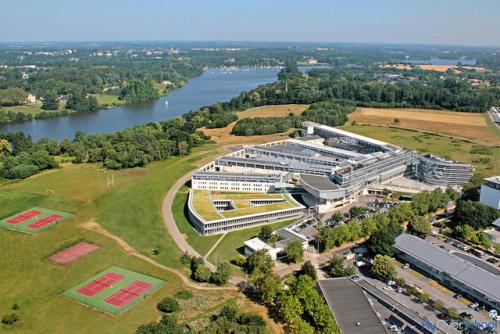
Nantes Campus
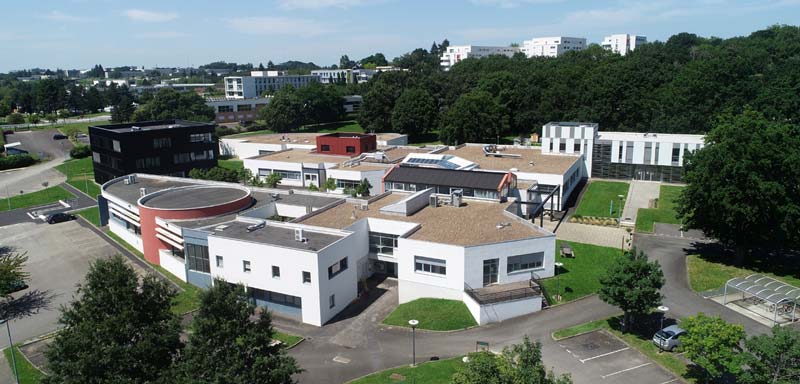
Rennes Campus
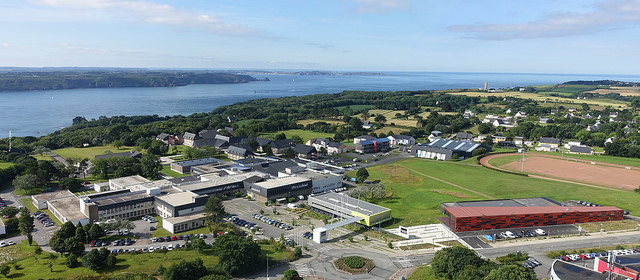
Brest Campus
IMT Atlantique
THE DEPARTMENT OF
AUTOMATION, PRODUCTION AND COMPUTER SCIENCES
(DAPI)
is part of the current revolution bridging the gap between the cyber and physical worlds. DAPI’s aim is to create adaptable industrial systems making the best possible use of the available resources, while remaining true to a philosophy of sustainable development. The Faculty members of DAPI and PhD students are also members of the CNRS Laboratory LS2N.
The department expertise spans a wide range of fundamental and applied skills including applied mathematics, operational research, industrial engineering, computer science, robotics and automatic control. Its research and teaching activities are organized around three training and research groups
Software Engineering and Distribution group
with three research teams.
The Stack team studies the challenges related to the management and advanced uses of Utility Computing infrastructures (i.e., Cloud, Fog, Edge and beyond).
The Naomod (Nantes Software Modeling Group) team that tackles challenges related to the continuous construction of software via model engineering, with numerous industrial applications in areas such as IoT or Cyber-Physical Systems (CPSs).
The Gallinette team is developing a new generation of proof assistants (for programming languages notably), with the belief that practical experiments must go hand in hand with fundamental research.
Optimization and Decision Aid group
with two teams.
MODELIS (Modelling, Optimisation and DEcision for Logistics, Industry and Services) develops analytical methods for optimisation and decision-making support in production, logistics and transports. The team’s contributions include the development of novel approaches (heuristics, meta-heuristics, or exact methods), as well as the modelling and resolution of new complex problems.
The TASC team (Theory and Applications of Constraint Systems) focuses on the theory and practice of combinatorial problem solving, a unifying and flexible paradigm combining optimisation and relaxation which accounts for both dynamic constraints and business rules.
Robotics, Control and Interactions group
with three teams.
CODEx (Command, Observation, Diagnostic and Experimentation) targets dynamic systems including continuous time, discrete time, linear systems, non-linear systems, or commutation systems as well as delay systems, in the domain of actuators, transport systems, renewable energies, the living.
ReV (Robotics and Living) works on robotics at the interface with the living as a source of inspiration (bio-robotics), or as the environment with whom a robot interacts with, in the industry domain and for the society (health, human assistance) via a multi-disciplinary approach.
The PACCE team (Perception, Action, Cognition for Design and Ergonomics) focuses on human-centered design, particularly virtual environments design, human-machine and human-human collaboration. From an application perspective, we are interested in dynamic activities, possibly with critical systems, such as medical procedures.
Le laboratoire des Sciences du numerique de Nantes
(LS2N)
A single objective : bring together Nantes’ research expertise in computer science and cybernetics to develop digital sciences, inclusive of other disciplines and taking account of the social challenges involved.
The lab of digital sciences of Nantes (“Laboratoire des Sciences du Numérique de Nantes : LS2N” in French) is a new Joint Research Unit (UMR 6004) created in January 2017, resulting from the grouping of the IRCCyN (UMR 6597 : Communication and Cyber Research Institute), and LINA (UMR 6241 : Computer Science Laboratory).
With a strong scientific talent at the heart of digital sciences, this large laboratory of 450 people participates fully in the digital revolution of our society on the scientific and technical subjects it implements. Research is performed consciously of the societal challenges that this revolution engenders, and remaining curious and openminded to other disciplines.
The complexity of the research objects that we are studying also forces us to adopt a global systemic approach in which computer concerns, automatic control, signal and image processing are interwoven in order to answer the questions asked by open, interactive, communicating and ubiquitous systems. The laboratory is an actor in innovation that values these objects with partners in its environment.
The LS2N is supported by 5 public institutions of Higher Education and Research. It is located in Nantes on 5 geographical sites.
Its research activity is structured in 5 areas of expertise :
- Signals, Images, Ergonomics and Languages,
- Data and decision sciences,
- Software and distributed systems sciences,
- Design and management of systems,
- Robotics, processes, calculation
and 5 cross-cutting themes :
- Factory of the future,
- Energy management and control of environmental impacts,
- Life sciences,
- Vehicles and mobility,
- Digital creation, culture and society